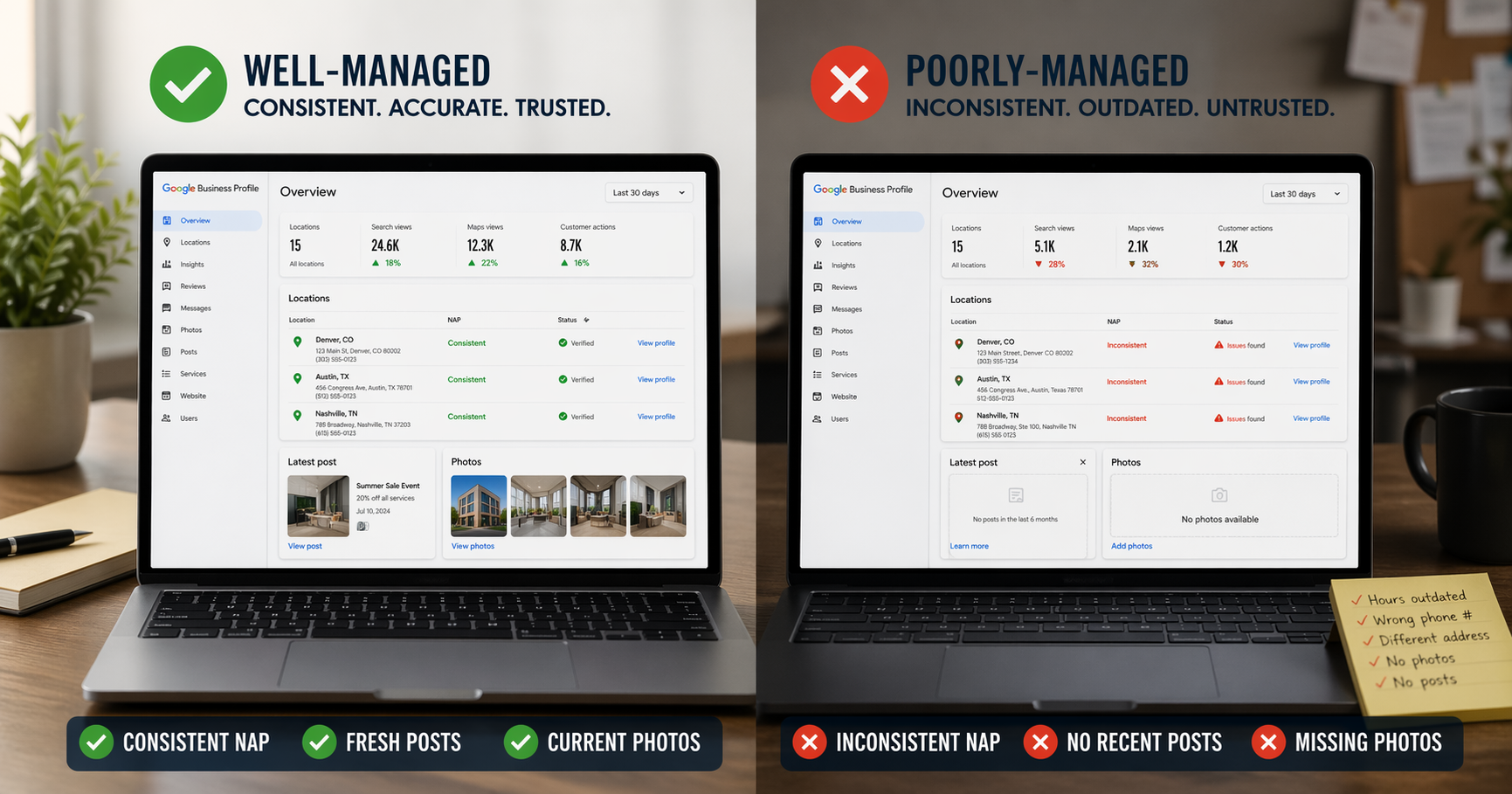
Most multi-location brands we meet have the same Google Business Profile problem. They have somewhere between two and two hundred locations, someone on the marketing team set everything up a couple of years ago, and nobody has touched it since. Posts are stale. Photos are old. Hours are wrong on at least one profile. Two locations are still showing addresses the company moved out of in 2023.
That is the messy middle of multi-location Google Business Profile management. It is where rankings die quietly while the marketing team focuses on bigger, shinier projects.
The companies that beat their competitors in the local pack are not necessarily the ones with the biggest brands or the deepest pockets. They are the ones that treat multi-location Google Business Profile management as an ongoing operational discipline instead of a one-time setup task.
Here is what mid-market brands get wrong, and what to do instead.
The core problem: treating GBP like a static listing
Single-location businesses can sometimes get away with a set-it-and-forget-it approach to Google Business Profile. Mid-market brands cannot.
When you have ten or more locations, every problem multiplies. A wrong phone number on one listing is annoying. A wrong phone number on forty listings is a measurable revenue loss. An outdated holiday hour on one profile means a few angry customers. Outdated holiday hours across a hundred profiles means thousands of failed visits and a noticeable spike in one-star reviews.
The companies winning local search at the multi-location level have figured out that GBP is not a listing. It is a publishing platform. And like any publishing platform, it needs an editorial calendar, an owner, and a quality control process.
The six mistakes we see most often
Our team audits multi-location GBP programs for all kinds of companies. The same six mistakes show up almost every time.
1. One person owns everything
The most common pattern is a single marketing coordinator owning all GBP profiles. They are stretched thin, they do not have local context for what is happening at each store, and when they leave the company, institutional knowledge walks out the door with them.
The fix is a tiered ownership model. A central marketing operations lead owns the program, the standards, and the platform. Each region or franchise group has a local owner responsible for accuracy and engagement at their specific locations. Headquarters publishes brand-approved templates. Local owners adapt and post.
2. Posts stop three months in
Most multi-location brands launch with great intentions. They post weekly for a month or two, then once a month, then never. Within a year, the average profile is silent.
Google Business Profile posts are a ranking signal. Not a huge one, but a real one. More importantly, they are a conversion signal. A profile with current posts looks alive. A profile with the most recent post from fourteen months ago looks abandoned. We have watched call volume from GBP drop 20 to 30 percent on profiles where posting stopped entirely.
3. Photos are old, wrong, or missing
We pull a sample of GBP profiles for every multi-location prospect, and the photo problem is universal. Either the photos are obviously stock images that do not match the actual location, or they are customer-uploaded photos that no longer reflect current branding, or there are simply too few photos for a brand of that size.
For a mid-market multi-location brand, the baseline is twenty to thirty location-specific photos per profile, refreshed at least quarterly. That sounds like a lot until you do the math: at one location, that is maybe forty-five minutes of photographer time twice a year.
4. Reviews sit without responses
Google’s local ranking algorithm rewards review velocity, average rating, and response rate. Profiles where the business responds to most reviews outrank otherwise identical profiles where reviews go unanswered.
The mistake we see is treating review responses as a customer service task instead of a marketing task. Customer service teams get pulled into a hundred urgent priorities. Reviews fall to the bottom of the queue. The fix is to assign review response to whoever owns the GBP program, with pre-approved templated responses customized at the local level.
5. NAP inconsistencies across the citation ecosystem
Name, address, phone — and now hours, services, attributes, and categories. Mid-market brands often have a clean primary website, but their citations across Yelp, Apple Maps, Bing Places, Facebook, and dozens of industry directories tell a different story. Multiple phone numbers. Old addresses from a previous office. Inconsistent business names (“Acme Plumbing” versus “Acme Plumbing and Heating LLC”).
Google reads all of these signals. Inconsistency hurts trust. We have seen brands gain three to seven local pack positions just by cleaning up citations across the top fifty data sources.
6. Categories and services get set once, never revisited
Google adds new categories and services every quarter. The categories you selected three years ago may no longer be the most accurate or the most strategic. We routinely find mid-market brands using outdated primary categories that miss obvious relevant traffic.
Once a quarter, someone needs to audit the full category and service list for every location and confirm it reflects what the business actually does today.
What good multi-location GBP management looks like
Here is what our team recommends as the minimum operating standard for multi-location GBP at a mid-market company.
A program owner. One person at the marketing operations level who owns the platform, the standards, the tooling, and the reporting. Not a vendor. Not a part-time task. Someone whose performance review includes GBP performance.
A documented standard. A written brand standard for every field on every profile. Categories, attributes, services, hours, photo specs, post cadence, response SLAs. New locations onboard against this standard. Existing locations get audited against it quarterly.
A monthly content calendar. At least four GBP posts per location per month, cross-published from a central content hub instead of written one location at a time.
A quarterly photo refresh. Twenty fresh location-specific photos per location per quarter, captured by a contractor or local team member trained on the brand standard.
A 24-hour review response SLA. Every review responded to within one business day. Five-star reviews get a brief, on-brand thank-you. Three-star and below get a personal, problem-solving response from someone with authority to make it right.
A monthly performance review. Ranking changes, search query reports, calls and direction requests, and review velocity tracked at both the network level and the individual location level. Anomalies investigated, not ignored.
The two tools we recommend (and the one we don’t)
For mid-market brands managing more than ten locations, manual management through Google’s interface stops working fast. You need a platform.
We recommend either Yext or BrightLocal for most mid-market clients. Yext is the more enterprise-grade option with deeper integrations and broader citation distribution. BrightLocal is usually the better fit for companies in the ten-to-fifty location range. Both let you push updates from a single source of truth to GBP and dozens of other directories at the same time.
What this should cost (and why most brands pay too little)
Mid-market brands typically underspend on multi-location GBP by a factor of three or four. The going rate for a well-run program is $50 to $150 per location per month, depending on volume and complexity. That includes platform fees, content production, photo refresh, review response, and reporting.
A fifty-location brand running a serious GBP program is spending $2,500 to $7,500 per month on the function. That sounds like a lot until you compare it to what those same brands spend on Google Ads — typically ten to thirty times more — and recognize that GBP traffic converts at two to three times the rate of paid search traffic for most local businesses.
The math almost always favors investing more in organic local visibility before scaling paid spend. Pair that with a steady authority and link building program and the local pack starts to feel a lot less competitive.
Where to start if your GBP program is a mess
If you are reading this and recognizing your own program in the problems above, here is the order we would run it in:
- Audit. Pull every profile. Score each one against your future brand standard. Identify the worst offenders and the systemic patterns.
- Standardize. Write the brand standard. Get it approved by leadership and legal if needed.
- Centralize. Move all profiles into a single management platform with proper user permissions.
- Onboard the team. Train regional and local owners on the standard and the tooling.
- Operate. Run the monthly cadence. Track. Report. Refine.
Most of our clients see meaningful ranking improvements within ninety days of putting this kind of program in place. By month six, local pack performance gains usually pay for the program several times over.
If you would like our team to audit your existing multi-location GBP setup and identify the highest-impact fixes, reach out for a conversation. We will send you a sample audit of three of your locations as a starting point, no commitment required.